Pages

Saturday, August 21, 2010

PINCC Training

Prevention Inernational: No Cervical Cancer is a US-based non-profit group whose focus is to improve cervical cancer screening and treatment in low-resource settings. They conduct trainings for healthcare providers on simple, effective, low-cost, and sustainable methods for screening and treatment.

Dr. Vijaya Srinivas, one of the physicians at PHRII, has been planning this training for many months. From developing the training manual, securing a clinical site, to recruiting physicians to be trained and patients to be seen, it has been a busy couple of months. All that planning paid off, as everything went without any problems!

Day 1 consisted of a presentation at PHRII by PINCC’s Dr. Rhoda. She presented a basic overview of the epidemiology of cervical cancer, as well as the screening and treatment methods being utilized during the training.

The presentation was open to the public and there were a few big names from Mysore in the audience, like the head of Mysore Medical College seen here.

Dr. Anjali Arun also made an appearance.

After the presentation there was some good dialogue about the state of cervical cancer in clinics throughout Mysore.
Day 2 was spent organizing the staff and setting up the clinic at St. Joseph’s Hospital, one of the newest hospitals in Mysore. Day 3, 4, and 5 were spent seeing patients and conducting the training.

The process was pretty complex. We had previously recruited patients from all over Mysore city, including Ekalavyanagar, the slum community we sponsored in 2008. We had to get all of these women to the clinic, so all three drivers were kept very busy shuttling patients to and from the clinic. Second, the patients had to be registered and then given a detailed explanation about the screening and examination procedures.

Next, the patients met with a counselor to fill out a basic clinical information sheet and to provide consent to participate in the program.

Finally, the patients were able to see the clinicians. Any women who did not meet the criteria to have the visual inspection done received a PAP, which was sent out to the pathology department at Vikram Hospital. Most women were found to have a healthy cervix. For the women with pre-cancerous lesions, the team was able to provide same-day treatment and obtain a biopsy for further testing. The team also identified other gynecological problems, including a few prolapsed uteruses.

Here's a pic of Dr. Vijaya and her new headlamp!

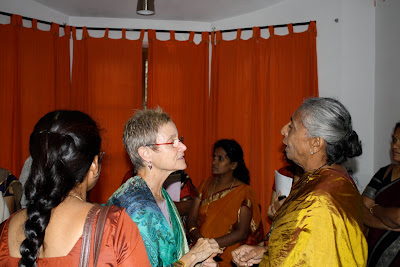
Women were typically nervous in the beginning, as this was the first pelvic exam for most of them! However, when the patients came out of the exam room with smiles on their faces, all the other patients were able to relax. The women were also able to comfort each other in groups before and after seeing the clinicians. Here are some satisfied patients who have already seen the clinicians.

All in all, the program was a great success! In 2.5 clinic days, we screened 139 women. This included 43 PAP smears, 15 biopsies, and 2 LEEP procedures (same-day treatment for pre-cancerous lesions).

We have plans to do another PINCC training in early December. There was also interest in starting a community referral network for cervical cancer screening amongst clinics and physicians in Mysore. Exciting news!

Hampi

Hampi is a famous historical site in Southern India. The site consists of ruins from Vijayanagara, the powerful Hindu Empire that ruled much of Southern India from the 13th – 16th centuries. Muslim armies fought and destroyed the Vijayanagara empire, along with many of its ancient temples. Most of the temples in Hampi have been restored to their original state.

Everyone who has visited has said the same thing to me: The overnight bus ride really sucks, but it’s totally worth it.

The main temple in Hampi is one of the larger ones at the site. It’s also the only active temple in town.


While it may not be as old as some of the other temples, it does have a resident temple elephant!


After dropping a Ruppee in her trunk, she hands it to her trainer, then blesses you on the head with her trunk. She’s very well-trained!


Walking about 10 minutes East of the city center,you come across a large Krishna temple and a 30-foot monolithic Ganesha, my favorite Hindu god.


We spent one afternoon walking along the riverbank to one of the oldest temples in India, Virupaksha. There are many old ruins that are scattered among the massive boulders that define the hillsides here. Here’s a small temple structure with a long staircase.


One of the most famous structures in Hampi, the Stone Chariot, is located inside the walls of the Virupaksha temple (built in the 7th Century!)


There is also a nice bath area just down the road.


The view from the top of Hemakuta Hill was amazing. Didn’t quite make it for sunrise like I had wanted, but it was probably for the better anyway, since the trail may have been a bit tricky to navigate in the dark, with sandals. The day view was still pretty good…..


An underground temple:


A structure at the royal palace grounds called Lotus Mahal. Great architecture!


Twelve stables for the Queen’s royal elephants.


We came across some guys who were carving various structures out of stone and selling them on the street. I don’t usually buy these things, as they seem too manufactured, but it was really fun watching the guys make the structures out of plain stone. After some haggling, I decided to buy a stone Ganesh. I was in a hurry to get some pictures of them, so I shoved the newspaper-wrapped Ganesh into my pocket and grabbed my camera. As I started to walk away, the Ganesh fell out of my pocket and onto the pavement. Whoooops. I opened it up and saw that the stone was pretty banged up on the part that hit the ground. Fortunately the guys were nice enough to smooth out all the chips and dents, but they didn’t think it was too funny. They wrapped it up in approximately 10 full newspapers and then handed it to Neesha to put into her purse. My bad, but at least I have a story….


Thursday, July 29, 2010

Kerala

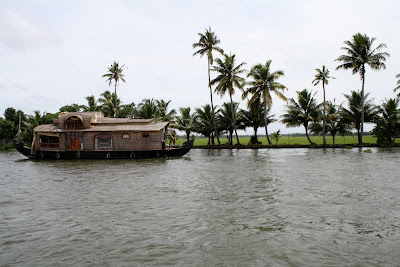
One of the highlights of a trip to Southern India is undoubtedly the backwaters of Kerala. Small canals and waterways are surrounded by dense, green vegetation and occasional rice paddies. The only way to experience these backwaters is aboardan old rice barge, or kettu vallam. Cruising along at a slow pace, with the soft humming of the diesel motor, provided us with an opportunity to enjoy the scenery and serenity of the backwaters.

Our kettu vallam:


The houseboat came with a driver and a chef. The chef was AMAZING! We received three large, freshly prepared Keralan meals. Lunch- Fish Fry (which is something that Kerala is know for), vegetable curry, coconut chutney;
Dinner- Spicy Tiger Prawns, Chicken Curry, veggies and dal ; Breakfast - Omlettes, Idli, Sambar. This was some of the best food I've had in India!

Some scenery shots:

Kochi is a small town just North of backwaters. It's an old sea port, with lots of European and East Asian influences. Here's a picture of the huge Chinese fishing nets that are scattered about the coast, most are still in use today.


Tpot- An awesome little cafe in Kochi. They have teapots from all over the world. Good black coffee is sometimes hard to get here and their's was amazing.

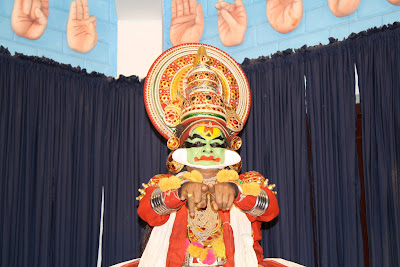
Kathakali- A Keralan dance that uses facial expressions and hand gestures/formations to convey Hindu stories and teachings. We got front-row seats to the show! We also happened to be the only people in the theater that night.


After our backwater trip, we spent some time at a beach on the Arabian Sea. The weather was gorgeous...
...for a while. This was the last photo I snapped off before the monsoon rain sent me sprinting for cover.

Wednesday, July 21, 2010

Back in Mysore!

Wow. It feels great to be back in India! It was great to walk out of the Bangalore airport at 3 in the morning, after a 22+ hour trip, and be greeted by Kantharaj’s familiar face.

We arrived in Mysore early that morning and I had time to take in the neighborhood. So much has changed since I was last in Mysore, but some things have remained the same. The old man up the street, “Namaste Guy”, greeted me with a very warm welcome. He’s adding a second floor to his house where his son’s family will stay. The family across the street from PHRII, Akash, Arun, Deepthi, and their mom, Divya were around that morning as well. Deepthi is stuyding engineering at a one of the best universities in the state, Arun is studying hard in college and working until 9pm every night, and Akash is dominating other 15-year-olds in shuttlecock (he won 2nd place at a regional tournament and took home a money prize!). The folks at Vikram Hospital canteen, where I ate 90% of my meals last trip, were surprised to see me back. One guy looked at me and said, “Two eggs and toast!”, which was my breakfast almost every morning (and in India, this is a very unusual breakfast). It felt great being back in the neighborhood.

PHRII blew me away, it’s grown so much! Two years ago, there were about 10 people, now there are close to 25 staff members, not including interns! This is great to see; I’m happy that Purnima and Karl’s hard work is paying off. It was wonderful to see several old faces Satya, Poornima, Fazila, Rani, and Bhavana. Everyoneis doing great!

Since I didn’t get to travel that much during my last trip to India, I’m hoping to get some destinations checked off my last list ASAP. I also have a lot of work to do during this summer (my to-do list keeps getting longer), but I hope to strike a healthy balance between the two. I’ll try to do a post for every trip that I make and scatter some work-related posts in between.

First, some pictures of Mysore.

Devaraja Market – the huge open-air market that takes up a large portion of the downtown real estate. It is such an exciting, vibrant, mesmerizingplace to visit.


Gokulum – My ‘hood and also the place where ALLLLL the yoga people are. People come from all over the world (literally) to do yoga here. It’s pretty neat, but it was so odd at first, seeing so many white people in India. I promised myself to try yoga again one of these days…..

My house - Four rooms and two bathrooms all to myself. You know I'm not going to get any furniture either....

Puppy dog friend! – The neighborhood dog that I see almost every day. It breaks my heart that he’s so skinny. I’m hoping that I don’t find a vet, otherwise I may vaccinate him and bring him back to the States.

Stay tuned, Kerala pictures coming soon…...

Friday, August 8, 2008

Ekalaavynagara Health Clinic #1


The clinic was sponsored by Prerana and coordinated by local community leaders. They provided us with an enclosed space to do examinations, a bed, desk, and chairs. All these items came in handy throughout the 5-hour clinic. Praba and Selvi handled the intake, Rani assisted Purnima, while Jana and I owned the 'pharmacy'. Jana's Kannada is far superior to mine, so besides counting pills, I was only good for giving old women Tylenol and vitamins. I would say "One-do tablet belige. One-do tablet rahtree." (One tablet in the morning, one at night). The sentence was consistently followed by a smile and,unfortunately, a hand-scrunch to the face.

Hundreds of people came to see our ONE doctor, and despite our best efforts to triage, there were some thrown elbows and arguments at the front of the line. Dr. Purnima was great, seeing about 80 patients, without a break. The sheer number of sick infants, children, and women demonstrate the needs of this community.

We quickly realized that we were understaffed and inadequately supplied. Almost every child seen in the clinic had some sort of bacterial infection; from superficial skin infections to lower respiratory tract infections to enteric diseases, these children need antibiotics. For this clinic, all we could do was write them a prescription or refer them to the hospital. We also need to develop a way provide nutritional supplements to the children that are chronically malnourished, as it is hard to fight off infections with an 'undersupplied' immune system.


(A little girl, following her mother's lead, carryies some sticks for a fire)

Overall, the health camp was a great start to a promising, long-lasting service to this community. We learned a lot, which we will carry through to our future clinics. We should improve with each and every clinic.

Friday, August 1, 2008

Ekalaavyanagara


A couple of weeks ago, while we were on outreach, we happened upon a squatter settlement just outside of the city. We decided to make an extra stop to see if there were any TBAs in the community. I stopped the van before we entered the village, so that we could get pictures from just outside the settlement.


While taking these pictures, we were confronted by several village people, who did not approve of us taking pictures of them. We told them who we were and why we were there. They took us to their Anganwardi center, which is a pre-school facility during the day and a multi-purpose room in the evenings. There we met with the Anganwardi teacher and several other older members of the community. These leaders informed us that many people have come to their community and taken pictures, while promising money and aid. However, they have not seen any benefit thus far, and organized themselves against the photographic exploitation by 'outsiders'.

Guilty, was the first emotion I felt, because it seemed I had violated them in some way. However, it was very moving to see them come together as a community to take a stand against these violations. After the meeting, I vowed that I would not be one of those 'outsiders' who just came, took pictures, and left. There must be something that I could do to help this community.


(pictured above: two of the huts with an average of 6 people living inside, the re-blanketed structure outside the right hut functions as the bathroom and is shared by more than one family)

Jana, the team, and I have since been to the village several times. On Wednesday,
Purnima, Karl, Jana, and I had a very promising meeting with 4 of their community leaders. The community is made up of tribal people from all around the state, who came to Mysore with the hopes of landing a job in city. It is a quintessential slum community; they are located in a industrial area on the edge of the city, they lack access to sanitation and healthcare, they are living in overcrowded huts made of clay, plastic, and palm fronds. Worm infections are rampant among the children, who also bear the tell-tale signs of vitamin deficiency. The complete lack of sanitation, and subsequent open-defecation are leading to other infections throughout the community.


The leaders are also trying to build an
Anganwardi building for their children, see pictures above. The current facility is completely dilapitated; a palm-frond roof characterized by gaping holes rendering the structure useless during monsoon season. They have organized the community and made this their priority. Plans are drawn up for a new Anganwardi center, and the foundation has been laid. Our goal is to raise enough funds to ensure that this project is completed and subsequently maintained by the community.


The health problems facing the children were paramount to this group of community leaders. These leaders are incredibly organized and devoted to their community, but with little resources they continue the struggle to provide a better life for the children. A compelling story to be sure. To help, we are going to raise money for monthly health camps, where the women and children will be given access to primary care. A massive de-worming project will begin in the community and this will bring better health to the children. Further down the line, we will work with the community to develop toilet blocks or household latrines. Sanitation is required to break the cycle of infection/re-infection among community members.


I will keep everyone posted on the status, but don't be surprised if I come to you to raise money. We have made a commitment to these people and it is important to me that I do everything in my power to follow through on this commitment. Our money can go such a long way in improving the lives of these people.